by Emeka Williams
To donate to our Corona Virus relief fund please click here

When the novel Corona virus first hit Wuhan, China, late last year, no one could have predicted the many negative effects the virus would cause to the health, wellbeing and economies of nations. What was once dubbed the “Chinese virus” by American President, Donald Trump, is no longer just a Chinese virus but officially a world pandemic.
Nigerians, in their usual spiritual approach to things, boasted that the virus could not survive under heat or humid temperatures. That proved false as the World Health Organization pointed out that “no evidence so far shows that the virus dies in heat or humid temperature”, while stating also that “it is yet to be proven that sunlight kills the virus”.
What started like a tiny mustard seed is now having many adverse effects in Nigeria. In the course of this write-up, we will be highlighting these effects.
With no cure in sight and a proper lack of equipment like ventilators or personal protective equipment, no one knows how many more the pandemic will claim.
DEATH TOLL
On the 1st of March, Nigeria recorded her first case of the virus when an unidentified Italian citizen (male) brought it into the country. In the aftermath of the discovery, several Nigerian senators lamented the situation where the nation’s airports were left unchecked with no medical facilities in sight to screen those coming into the country.
Today, while the same Italian man has recovered from the virus, many others have succumbed to the invisible enemy.
According to Worldometer, the latest statistics on the virus in Nigeria reads that there have been 541cases and 19 deaths. With no cure in sight and a proper lack of equipment like ventilators or personal protective equipment, no one knows how many more the pandemic will claim.
THE ECONOMY
This sector has arguably been the worst hit by the corona virus. The World Bank/International Monetary Fund has already declared world economies to be in recession. In Nigeria, where crude oil is the major export, its price per barrel–$60—before the virus struck, has tumbled down to $20 per barrel. This is according to a BBC report which described it as the “worst fall in the last 20 years”, thus, rubbishing the budget estimates for the current year.
“worst fall in the last 20 years”
The threat of the virus has long forced many countries to shut down their industries and go into lockdown in order to curb the spread of the virus, while also seeking ways to find the cure. This automatically means that monies are not being made, especially with major economic hubs like ‘Alaba market’ and ‘Computer village’ in Lagos metropolis shut down. This means that while monies are still being spent by the government to offset salaries and other expenditures, there is no corresponding income to compensate the spending.
THE CITIZENRY
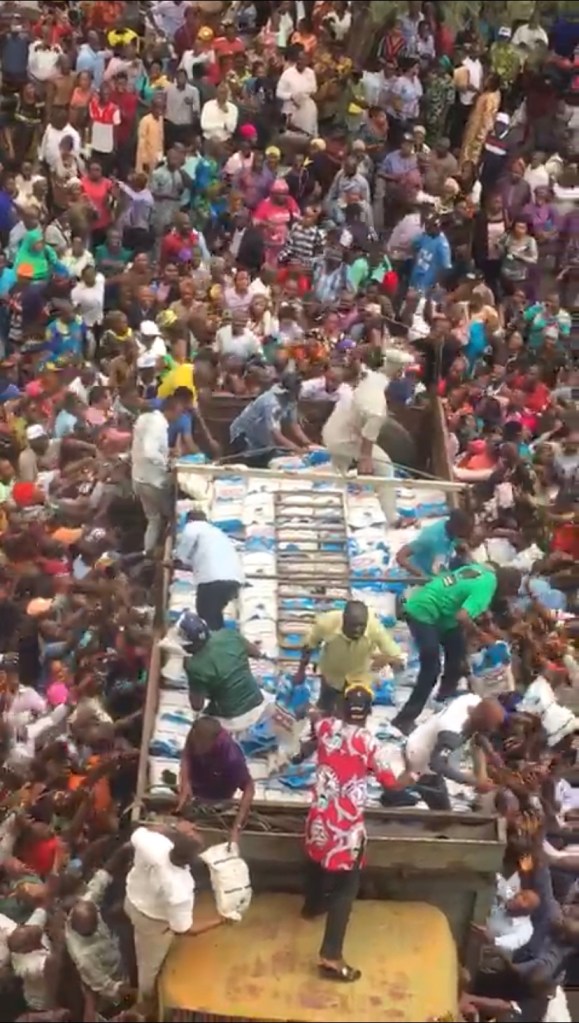
While the government is counting their losses, its citizens are also on the receiving end of the virus. Since Nigeria, like every other country, is yet to find a cure for the virus, she has been forced to lockdown every “public gathering”, work place, and other commercial centers. This means that a vast majority of its citizens have been rendered jobless (including the gainfully employed), with little or nothing to do to make a living for the time being, especially those that earn their living by the day.
It is not too hard to fathom, since people are supposed to observe social distancing and self-isolation, contracts have been terminated and persons have been left spending that which was saved up before the pandemic. While a few workers like the civil and public servants, journalists, and a few others, still earn money during the lockdown, the ratio of those not in this bracket far exceeds the number of those within it.
People are practically begging for food. On severally occasions, trucks conveying foodstuffs to major markets (bags of rice, garri and bean) have been robbed in broad daylight by hungry, angry and frustrated Nigerians, all because of the suffering that came with the lockdown.
When quizzed by this writer, an electrician, Kayode Idowu, who lives in Lagos State, explained the hardship he and his family have experienced since the lockdown was enforced in many states in the country.
“I have not been able to make One Naira since this lockdown started, the little one I managed to save up before now is almost finished. As it is, if this lockdown continues, I may resort to begging, or even stealing, because I must survive,” he concluded.
These songs of sorrow being sang by, not one, but the majority of the populace, as a result of the corona virus outbreak, brings us to another salient effect the virus has had in Nigeria.
INSECURITY
It is no longer news that in Lagos, Nigeria, a new wave of crime groups has recently emerged. These notorious gangs known as ‘One million Boys’, No Salary’, ‘K-Sarri’, and ‘Awawa Boys’ among others, have for long, robbed and maimed innocent civilians with impunity. Their activities have upped a notch since the pangs and after effects of the corona virus lockdown started biting hard. Residents of Lagos and Ogun state constantly see these robbers rob them of the little monies they have saved up in broad daylight. Other states like Kano, Nasarawa and Enugu have also witnessed their fair share of an increased crime wave within their boundaries.
In saner climes, the security apparatus of the country will be queried in times like these, but in our dear country Nigeria, rather than deescalate the situation, our security agencies have further escalated the situation.
The National Human Rights Commission (NHRC), in a report about the nation’s lockdown, found evidence of 8 different incidents of extrajudicial killings which has led to 18 deaths. The same report also stated that over a hundred complaints have emanated from Lagos, Abuja, Ogun and 21 other states in the federation.
INFLATION
This last effect is being felt more by the general masses. Since the eve of the lockdown, there has been a spike in the prices of food commodities, cost of utility bills, and other such.
A shop owner, Margret, who sells in the Ijora part of Lagos state, explained that the high cost of the goods she sells is due to the fact that the middle men and manufacturers who sell to her find it hard distributing these goods during the curfew and lockdown. As such, she explains that she and other business woman are forced to increase the prices to compensate.
While the aforementioned effects could very well still linger on, it is the hope of Nigerian citizens that its government could replicate the acts of countries like the United States of America, who currently distributed a stimulus check to its citizens. Such relief funds could not come at a better time to them.
In a similar vein, the Nigerian government, like many other countries, will be hoping that a cure is found and things return to normalcy (or at least something resembling it). However, for the virus to be defeated and its many negative effects nullified, we will need more than just scientific researches but also prayers for God’s intervention.
To Donate: Click here
or Zelle: godcoverchurch@yahoo.com
 A.G. Project